Peaceful Pleasures Health and Wellness
Leather Craft Isometric Divider Ruler | Equal Spacing Tool
Leather Craft Isometric Divider Ruler | Equal Spacing Tool
Couldn't load pickup availability
Precision Equal Spacing for Leather Crafting
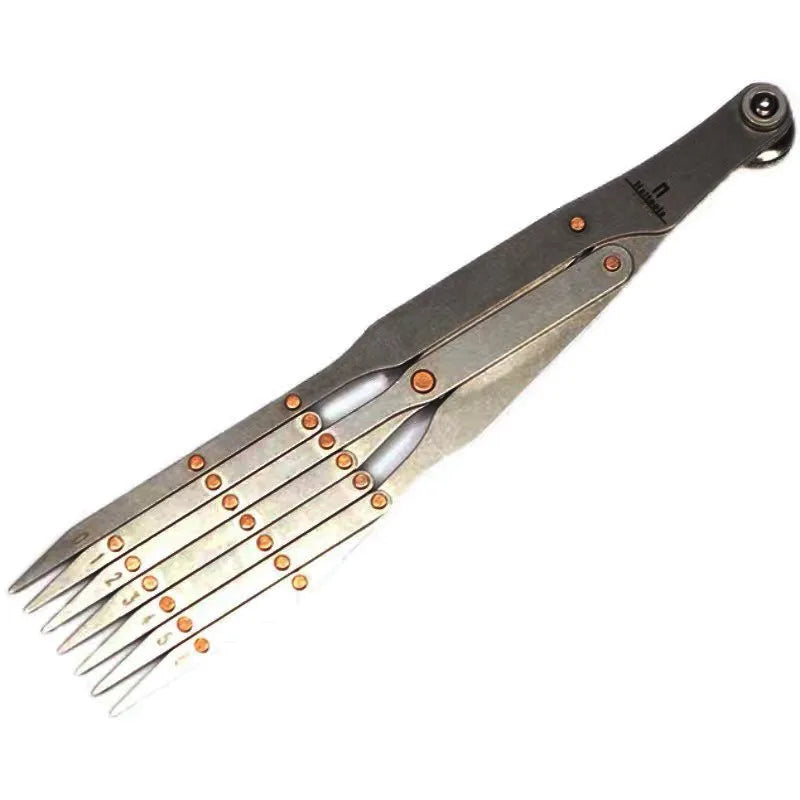
Whether you're crafting belts, watch straps, shoulder bags, or waistbands, achieving perfectly even spacing is one of the most challenging — and most important — aspects of leatherwork. This Stainless Steel Isometric Divider Ruler takes the guesswork out of marking equal divisions on any leather piece, giving you consistent, professional results every time.
Available in three sizes (S, M, L), this compact marking tool fans open to set your desired spacing, then locks in place (M and L models) so every mark lands exactly where it should. Ideal for installing decorative nails, spacing eyelets, punching stitch lines, and marking horizontal seams on belts and straps.
Key Features
- Equally Spaced Marking: Divides any segment into equal parts instantly — no math, no measuring tape fumbling.
-
Three Sizes Available:
- L (11 teeth): Spacing range 3.6mm – 25.4mm
- M (7 teeth): Spacing range 3.4mm – 25.4mm
- S (5 teeth): Spacing range 3.0mm – 25.4mm
- Locking Function: M and L models feature a secure locking mechanism to hold your chosen spacing — no slipping mid-project.
- 301EH Stainless Steel Construction: Durable, slightly magnetic, and built to withstand regular workshop use.
- Left-Handed Version Available: Contact our customer service team if you need a left-handed configuration.
Specifications
| Material | 301EH Stainless Steel |
| Models | S (5 teeth), M (7 teeth), L (11 teeth) |
| Spacing Range | 3.0mm – 25.4mm (varies by model) |
| Locking Function | Yes (M and L models only) |
| Country of Origin | Made in China |
Use Cases
- Decorative nail and rivet installation
- Equidistant eyelet punching
- Shoulder strap and belt punch marking
- Watch strap and waistband stitch lines
- Any DIY leathercraft project requiring uniform spacing
Important Usage Notes
- The S model does not include a locking structure due to its compact design.
- This tool is designed for marking and spacing — do not use it as a chopper or strike it with a mallet.
- Measurement tolerance is approximately ±0.5mm; suitable for visual segmentation and practical crafting, not laboratory-precision measurement.
- Minor color variation may occur between product photos and the actual item due to monitor differences.
Explore More Craft & DIY Tools
Looking to expand your creative workspace? Check out these popular picks from our store:
- "1% Better Every Day" Motivational Canvas Poster | Wall Art
- "Everything Is Figureoutable" Sage Green Quote Canvas Wall Art
Authoritative Resource
For guidance on safe tool handling and workshop safety best practices, visit the OSHA Hand Tools Safety page.
Frequently Asked Questions
Q: What is the difference between the S, M, and L leather isometric divider ruler models?
A: The S model has 5 teeth with a spacing range of 3.0mm–25.4mm; the M model has 7 teeth with a range of 3.4mm–25.4mm; and the L model has 11 teeth with a range of 3.6mm–25.4mm. Both the M and L models include a locking mechanism to hold your spacing setting securely, while the S model does not due to its compact construction.
Q: Can this isometric divider ruler be used on materials other than leather?
A: Yes! While it's specifically designed for leathercraft projects like belts, watch straps, and shoulder bags, it can also be used on other flexible materials where equally spaced markings are needed. It works great for fabric, cork, and thin rubber materials.
Q: Is a left-handed version of this spacing divider tool available?
A: Yes. All models are available in left-handed configurations. Simply reach out to our customer service team when placing your order and specify that you need the left-handed version.
Q: How accurate is this leather craft spacing tool?
A: The tool is designed for practical, visual-level accuracy with a tolerance of approximately ±0.5mm. It is ideal for leathercraft and DIY projects where consistent spacing is important, though it is not intended for laboratory or engineering precision measurements.