Oasis Select
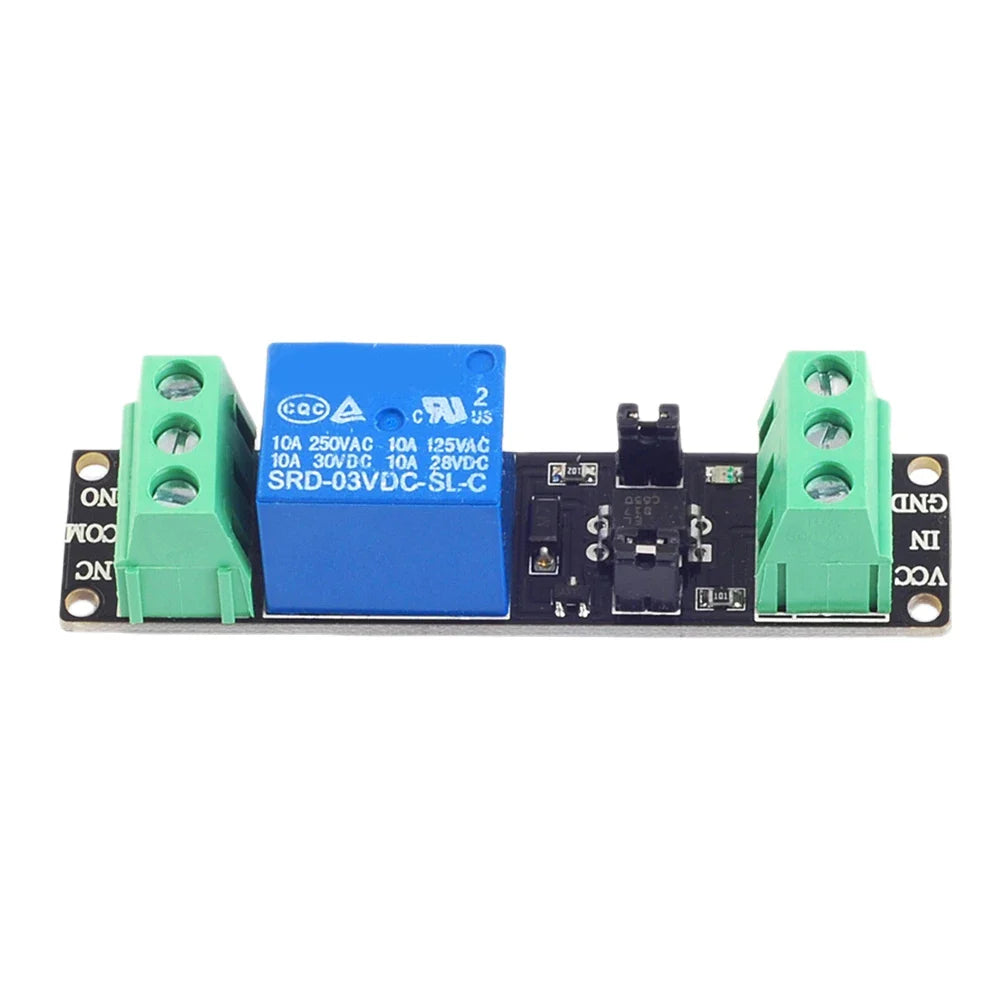
DC 3V/3.3V Optocoupler Relay Module – Isolated Drive Control Board
DC 3V/3.3V Optocoupler Relay Module – Isolated Drive Control Board
Couldn't load pickup availability
DC 3V/3.3V Optocoupler Relay Module – Isolated Drive Control Board
Take full control of your electronics projects with the ALLOYSEED DC 3V/3.3V Isolated Drive Control Board Relay Module. Designed for makers, hobbyists, and engineers, this compact optocoupler relay module delivers fast, reliable signal switching with built-in optical isolation — keeping your microcontroller safe while driving high-power loads. Compatible with Arduino, Raspberry Pi, ESP8266, and virtually any MCU platform, it's the dependable switching solution your automation projects demand.
Made in Mainland China.
Key Features
- Output Signal Indicator LED: Instantly confirm relay status at a glance — no guesswork required during testing or deployment.
- MCU-Compatible High-Level Trigger: Signal input connects directly to any microcontroller I/O pin. Supports 3V and 3.3V logic levels for seamless integration.
- Dual Power Supply Design: Independent control and load power supplies deliver strong anti-interference performance and rock-solid optical isolation, protecting your MCU from voltage spikes.
- Diode Reverse-Current Protection: Built-in flyback diode guards against reverse EMF, protecting both the relay coil and your circuit from damage.
- Fast Response & Long Service Life: Response time under 20ms and rated for up to 100,000 switching cycles — ideal for continuous automation and control applications.
- High Load Capacity: Capable of controlling loads up to 10A @ 250VAC or 10A @ 30VDC — suitable for lighting, motors, solenoids, and more.
Specifications
| Brand | ALLOYSEED |
| Operating Voltage | DC 3V / 3.3V |
| Main Components | EL817 Optocoupler, SRD-DC03V-SL-C Relay |
| Max Load (AC) | 10A @ 250VAC |
| Max Load (DC) | 10A @ 30VDC |
| Response Time | < 20ms |
| Relay Lifespan | 100,000+ operations |
| Trigger Type | High-level trigger |
| Dimensions | 70 × 20 × 17mm (2.76 × 0.79 × 0.67 in) |
| Weight | 20g |
| Country of Origin | Mainland China |
What's in the Box
- 1× DC 3V/3.3V Isolated Drive Control Board Relay Module
Perfect For
- Arduino, Raspberry Pi, ESP8266/ESP32 automation projects
- Home automation and smart device switching
- Industrial control and signal isolation circuits
- Motor, lighting, and solenoid valve control
- DIY electronics prototyping and robotics
Looking for more electronics accessories? Check out our 10-Pack 22AWG Glass Tube Fuse Holder Set and our 100W Dual-Port Fast Car Charger for more reliable power and circuit protection solutions.
For technical standards and electrical safety guidance, refer to the U.S. Consumer Product Safety Commission – Electrical Safety resources.
Frequently Asked Questions
Q: Is this optocoupler relay module compatible with Arduino and Raspberry Pi?
A: Yes! The DC 3V/3.3V relay module is fully compatible with Arduino, Raspberry Pi, ESP8266, ESP32, and any other microcontroller that outputs a 3V or 3.3V high-level signal on its I/O pins. Simply connect the signal pin from your MCU to the module's input and it will trigger reliably every time.
Q: What is the maximum load this relay module can switch?
A: This isolated relay module can handle loads up to 10A at 250VAC or 10A at 30VDC, making it suitable for controlling household lighting, small motors, solenoid valves, and other moderate-power devices safely from a low-voltage microcontroller signal.
Q: Why does this relay module use optical isolation (optocoupler)?
A: The EL817 optocoupler provides complete electrical isolation between the low-voltage microcontroller side and the high-voltage load side of the circuit. This protects your MCU from voltage spikes, noise, and back-EMF that can occur when switching inductive loads, greatly improving the reliability and longevity of your entire project.
Q: What does the dual power supply design mean?
A: The dual power supply design means the control circuit (MCU side) and the relay coil/load circuit are powered separately. This minimizes electrical interference between the two sides, ensuring stable and accurate relay switching even in electrically noisy environments.