Peaceful Pleasures Health and Wellness
12V Bistable Latching Relay DPDT HFD2 | 2A 30VDC 1A 125VAC
12V Bistable Latching Relay DPDT HFD2 | 2A 30VDC 1A 125VAC
Couldn't load pickup availability
12V Coil Bistable Latching Relay – DPDT HFD2-005-S-L2-D
This compact 12V bistable latching relay (DPDT, 10-pin) is an ideal pick for electronics hobbyists, engineers, and DIY circuit builders who need a reliable, low-power switching component. Unlike standard relays, a bistable (latching) relay holds its switched state without continuous coil power — saving energy and reducing heat in your projects.
With a silver-gold alloy (Ag-AuAg8) contact material, ultra-fast 4ms operate / 3ms release times, and a wide operating temperature range of -40°C to +85°C, this relay performs consistently across a broad range of applications including automation circuits, microcontroller projects, and DIY home electronics.
Made in Mainland China.
Key Features
- Type: Bistable / Latching Relay – holds state without continuous coil power
- Contact Form: 2CO (DPDT – Double Pole Double Throw)
- Coil Voltage: 12V DC
- Contact Rating: 2A @ 30VDC & 1A @ 125VAC
- Contact Material: Ag-AuAg8 (Silver-Gold alloy) for low contact resistance & long life
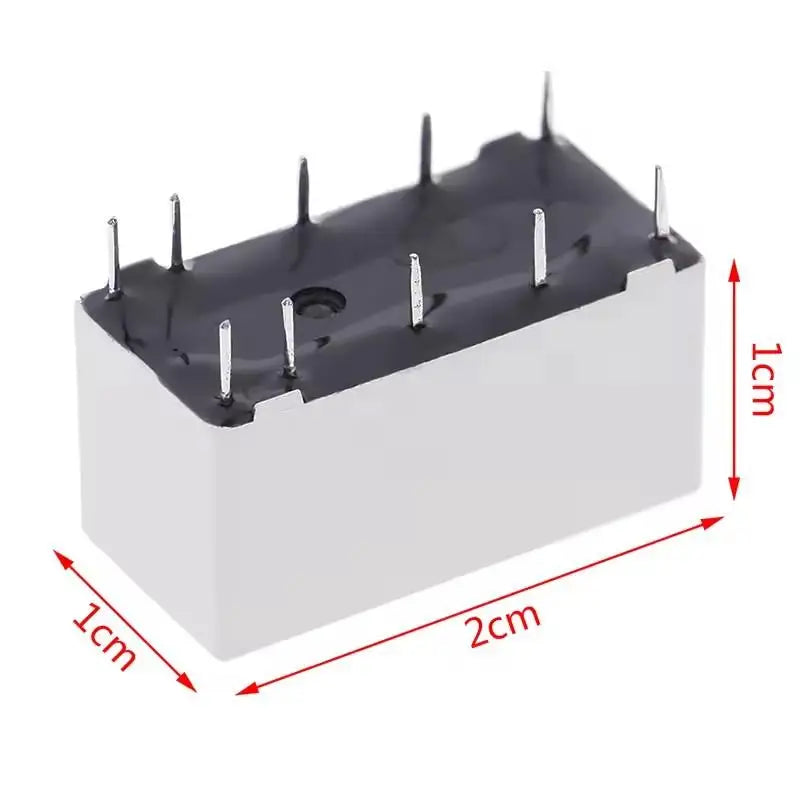
- Pins: 10-pin through-hole configuration
- Operate / Release Time: 4ms / 3ms
- Coil Consumption: 150mW (low power draw)
- Temperature Range: -40°C to +85°C
- Compact Size: approx. 2 × 1 × 1 cm (0.79 × 0.39 × 0.39 inch)
- Material: Plastic housing + Metal contacts
- Color: White
Full Specifications
| Parameter | Value |
|---|---|
| Model | HFD2-005-S-L2-D |
| Coil Voltage | 12V DC |
| Contact Form | 2CO (DPDT) |
| Contact Rating (AC) | 1A @ 125VAC |
| Contact Rating (DC) | 2A @ 30VDC |
| Contact Material | Ag-AuAg8 |
| Operate / Release Time | 4ms / 3ms |
| Coil Consumption | 150mW |
| Temperature Range | -40°C to +85°C |
| Dimensions | ~2 × 1 × 1 cm |
| Pins | 10-pin through-hole |
| Housing Color | White |
| Origin | Mainland China |
What's in the Box?
- 1 × HFD2-005-S-L2-D 12V Bistable Latching Relay
Common Applications
- Arduino / Raspberry Pi & microcontroller switching circuits
- DIY home automation and smart switch builds
- Battery-powered IoT devices requiring low standby power
- Telecommunications & signal routing equipment
- PCB prototyping and electronic project boards
For general safety guidelines when working with electrical components, refer to the U.S. Consumer Product Safety Commission – Electrical Safety.
You May Also Like
- "1% Better Every Day" Motivational Canvas Poster | Wall Art
- "Everything Is Fine" Funny Men's Graphic T-Shirt | Cotton Tee
Important Notes
- Product images are for illustration only — please refer to the written specifications for exact dimensions.
- Minor measurement variations (±1–2mm) may occur due to manual measurement.
- Color displayed may vary slightly depending on your monitor's calibration.
Frequently Asked Questions
Q: What does "bistable latching relay" mean, and why does it matter?
A: A bistable latching relay has two stable positions — it switches ON with a pulse and stays ON without needing continuous coil power. It only needs another pulse to switch OFF. This is perfect for battery-powered or energy-sensitive projects because the coil draws zero power between switching events, significantly reducing overall power consumption.
Q: What is DPDT and how many circuits can this relay switch?
A: DPDT stands for Double Pole Double Throw. This relay can simultaneously control two independent circuits, each with a common, normally-open (NO), and normally-closed (NC) connection — giving you flexible switching options in a single compact component.
Q: Is this relay compatible with Arduino or Raspberry Pi projects?
A: Yes. With a 12V coil and just 150mW coil consumption, this relay works well in microcontroller-driven circuits when paired with a suitable transistor or relay driver module to handle the coil switching from a 3.3V or 5V GPIO pin.
Q: What are the contact ratings, and can it switch mains voltage?
A: The contact is rated at 1A @ 125VAC and 2A @ 30VDC. While 125VAC is within the low-voltage range, always follow local electrical codes and safety standards when working with any AC circuit. This relay is best suited for low-current signal and control applications rather than high-load mains switching.